This is another guest post by Tim Walsh, avid adventurous traveler. Enjoy!
I recently went on a five day Amazon tour in the Tapiche Reserve in the Peruvian rainforest. I was a little nervous at the prospect of five days in the jungle without a cell phone, with intermittent electricity, plenty of dangerous animals nearby and the closest medical facility being four hours away, but luckily it turned out to be the experience of a lifetime.
I had always wanted to see the Amazon Rainforest, getting as far off the beaten path as feasible. Since I travel to Peru frequently for work, I was able to head down early for one planned visit and take some vacation. Some friends had recommended looking for Eco-Tourism trips out of Iquitos, a city located deep in the Peruvian rainforest. TripAdvisor had a lot of recommendations for guided tours, but the one that jumped out at me most was the Tapiche Reserve.
The Tapiche Reserve (http://www.tapichejungle.com) had spectacular ratings on TripAdvisor, and it seemed geared towards travelers who wanted an authentic experience. Its located about 400 km to the south of Iquitos, down the Amazon river – so I knew “getting off the beaten path” wasn’t going to be a problem. What really sold it though was the TripAdvisor reviews – all of them spoke very highly of the guides and the wildlife – they catered to nature lovers and conservationists, not like some other tours that housed some caged animals and were more geared towards the travelers seeking Ayahuasca-induced hallucinogenic trips. It seemed a little risky, but after speaking with the owner on the phone for a while, I decided to give it a shot and booked the trip.
I took a 1.5 hour flight from Lima to Iquitos to start the trip. Iquitos is located deep in the Peruvian Rainforest, but is not a picturesque town. The infrastructure is poor, and most of the vehicles are noisy buses or even more noisy motorbikes, which makes moving around the city a nerve-wracking experience. The city is an important trading port on the Amazon, from which many local products (timber, oil, mineral resources) are exported. It grew rapidly in early 20th century when rubber was in high demand, as European colonizers came to make their fortunes, but then much of the industry moved to Southeast Asia. During this time, local indigenous tribes were widely abused. And with the colonizers also came Catholic missionaries, who moved into the jungle and encouraged indigenous tribes to move to towns along major rivers from which they would be easier to proselytize. Widespread poverty and environmental degradation were unintended byproducts of this phenomena, however, tribes lost their ability to live off the jungle in a sustainable way as they had done for centuries. So on my way to see the “untouched jungle”, I’d pass through a lot of areas that had drastically changed over the past 100+ years.
From the Green Track Hostel in Iquitos, the plan was to depart at 5am, catch a 2 hour busride to Nauta, then get on a high speed boat ride 200 km down the Amazon River to Requena, then another 200 km or so on a motorboat down the Tapiche River, a tributary off the Amazon. During the first night there was widespread protests – we awoke to trash strewn throughout the streets, and a few small, scattered fires where trash was burned. This all made me even more excited to get out of the city, but unfortunately all workers were on strike – including the transportation companies. I couldn’t tell you the specific reason they were striking, but I’ve worked long enough in Latin America to expect impromptu general strikes, so it wasn’t that much of a surprise.
Luckily, everything went as planned the following day. The first two legs were cramped, but the final four hour leg along the Tapiche River was beautiful. We were taken in a small motorboat by Jose, a local indigenous man who acted as our guide for the remainder of the trip, and were treated to views of pink and gray river dolphins and other exotic wildlife along the way. All in all it was a 10 hour trip – somewhat stressful, but certainly worth it once we arrived at the Tapiche Reserve.
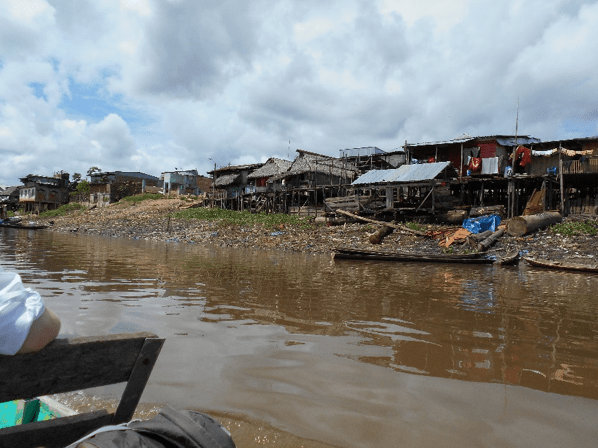
Leaving in Requena, Peru, on a motorboat and setting out for the final 4 hour leg down the Tapiche River to the Reserve.

Boat ride down the Tapiche River on the way to the Reserve, with Joachem, Jose and myself.

Arriving at the Tapiche Reserve.
The Tapiche Reserve is a privately owned, 14,000 acre parcel, covered entirely by dense jungle and rivers. The owner is a Brazilian nicknamed Katoo. A review on TripAdvisor said the nickname was given to him because he summited K2 (I didn’t confirm this with Katoo, but it wouldn’t surprise me). He’s also an engineer who speaks fluent German, Spanish, English, and Portuguese. Katoo grew up in the rainforest in Brazil, and has an inspiring sense of appreciation for the jungle. It became obvious on the boat ride there how necessary his efforts at conservation are.
It was sad to see the state of rainforest conservation along the 10 hour trip to the Tapiche Reserve. There are few economic opportunities available, so locals end up looking to the jungle for sustenance, often in unsustainable ways. Illegal logging is prevalent – we saw quite a few small groups of locals floating up the river on a raft made of felled trees. Poaching also happens frequently, especially for animals such as monkeys, sloths, and particularly of turtle eggs. Turtles lay their eggs in sand along the banks, and their footprints make them easy targets for poachers. I learned that the Tapiche Reserve is one of the success stories in the area, though that status is precarious, as Katoo frequently has to patrol the river banks protecting against unwanted loggers and poachers that encroach upon his land.
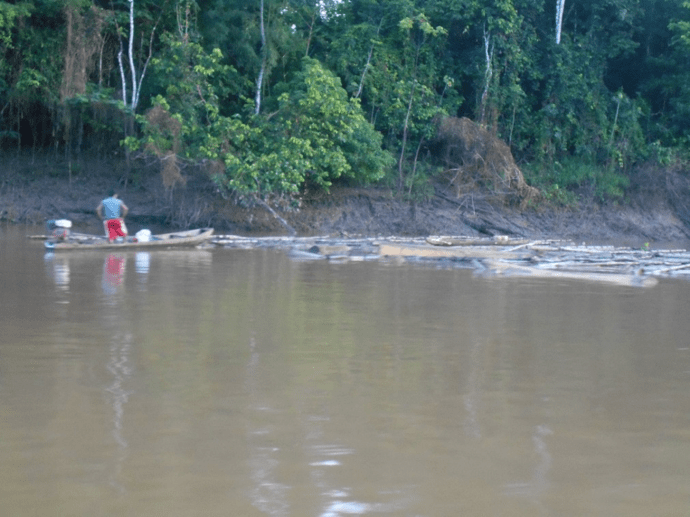
Loggers (most likely illegal) floating their cargo upstream.
The lodging at the Reserve has good but Spartan facilities. The wooden lodges have mosquito nets and beds, there’s a couple bathrooms and showers, and a dining hall. The cook is extremely nice, has a good sense of humor and likes to practice his English with visitors. There is no electricity most of the day, except an hour or two at night when the generator is turned on so people can get showers, eat dinner under the lights, and charge up their cameras (cell phones don’t work after you leave Requena). But the facilities are more than enough, because most of the time we spent in the jungle –we were only at the lodge to sleep or eat.
Over the next two days, we went a long hike in the morning and a canoe ride in the afternoon, with the goal of seeing as much wildlife as possible. Each time we took a different route – which is not difficult considering the size of the Reserve. Most days I traveled with Jose, our guide, and Joachem, a Dutch traveler.
The conditions on the hikes were…interesting. After a quick breakfast at 5am, for about 7-8 hours total, we would silently walk through the jungle, led by Jose. In some parts there was a beaten path, but much of it required a machete. Mosquitos were everywhere, so I reapplied with DEET about every half hour. It was in the high 80s most days, and incredibly humid.
However, the incredible wildlife we saw made it all worth it. At night over dinner, Jose would go through a wildlife book with my and I’d write down what we saw that day. A few of the highlights are: grey dolphin, pink dolphin, wooly monkey, red uakari monkey, common squirrel monkey, capuchin, tamarin, river otters, anteater, piranhas, paiche, toucans, kingfisher, horned screamer, collared forest falcon, great egret, anhinga, and nightjars.
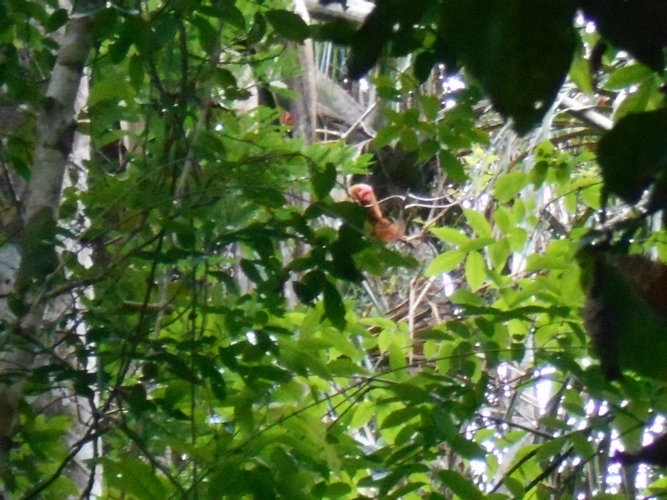
Red uakari monkey. Clearly I didn’t have a great camera with me…
None of this would have been possible without our guide, Jose. He had an amazing ability to spot animals that we never would have seen on our own. He would frequently motion for us to stop during the hike and be silent, as he pointed in the direction of a sound that oftentimes would turn out to be a monkey, anteater or bird. One time he did this, and four minutes passed by in which he was completely silent. I have good eyesight and my ears work fine, but I hadn’t noticed a thing. I was about to suggest giving up and keep moving, when out of nowhere two Whooly monkeys shot out from a tree right above us. Over the next five minutes, ten more monkeys did the same. It was incredible to see them in their natural habitat, rather than caged in zoo. I asked Jose how in the world he knew they would be coming right over our heads, and how he even knew they were close by at all. He said he heard something (tree branches breaking most likely) far off to both our left and right, and thought there was a good chance they would be moving in a line, escaping a predator such as a hawk or eagle. His six sense produced similar stories like this throughout my time there (including spotting a sloth 100 feet high in the canopy while speeding down the Amazon at 40 mph).
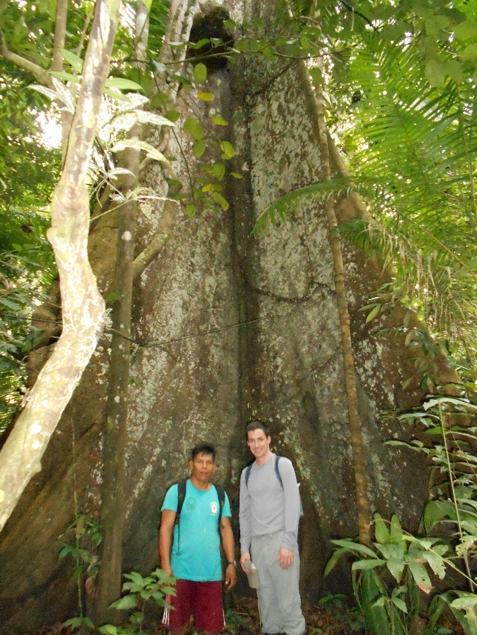
Our guide Jose and me.
The afternoon canoe rides were just as interesting. These weren’t easy strolls along the lake…what made them so difficult was that, even though Jose said he had been along these same creeks just two weeks before, every five minutes we would come along a new blockage made from fallen trees and brush that formed mini dams. At the sight of the first one, I thought there was no way we were getting through, and our trip would get cut short. Little did I know, each day we would make it through about 20 of those, many of which contained multiple trees of 2 feet or more in diameter. Some obstacles we would go around, but most we had to go through – with Jose and his machete leading the way.
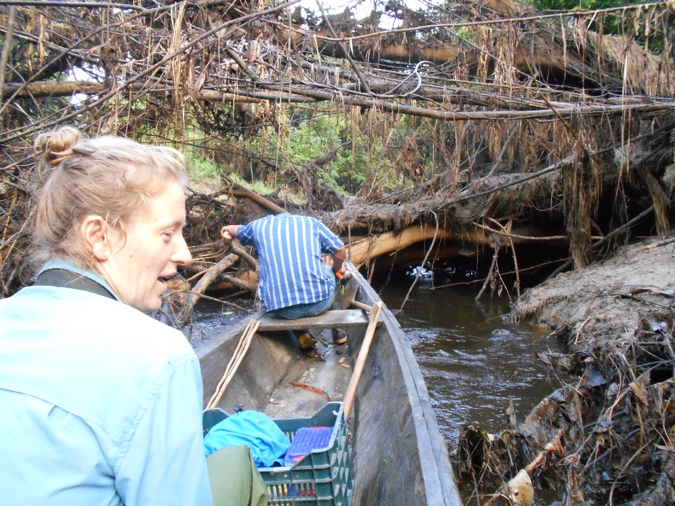
One of the many dams we encountered on our daytime canoe rides. It took us about 20 minutes to get through this one, but somehow we made it.
Youtube video of my confrontation with a family of river otters
Jose, all of about 5’4”, never seemed to tire. After a few hours the second day, I offered to lead through one of dams, hoping to give Jose a rest. I spent twice the time Jose did, and still didn’t get us through. Besides the lack of endurance and muscle, I didn’t know how to properly swing the machete – so I ended up spending more time trying to pull it back out of logs after hitting them than actually swinging it. Joachem and I would also try to help by grabbing nearby logs and helping to push the boat along, to varying degrees of success. Once I tried pushing off against an unsteady log which led to me falling halfway in the river, and another time my attempt to help led to me getting stung by a venomous ant (I’m not sure which kind it was, but it was not one of the more severe ones such as Bullet ants). Jose might have appreciated the attempts at helping, but he still ended up having to do 99% of the work.
On the last day, we switched it up a bit and spent the day on a long boat ride to a lagoon on the Reserve. To get there, we had to head down the Tapiche River, then navigate another small tributary off of it. This tributary was filled with dams that Jose and his father – another Tapiche employee – amazingly got us through. (At one point, when we seemed to be lodged on top of a fell log that we couldn’t pass, Jose’s father jumped out of the boat and into the water, somehow physically lifting us off the obstacle, then jumped back into the boat, soaking wet.) What made the lagoon so special was that it’s not easily accessible by boat traffic or poachers, so the wildlife there is more protected. There we saw dozens of Black Caimans, river dolphins, paiche, a few different types of monkeys, and who knows how many species of birds.

Head of a 2 meter long Black Caiman we came across in the lagoon.
At one point we took a break to go fishing…for piranhas…using other piranhas for bait. We would catch some, cut them up, and then use the bait to catch larger piranhas that we cooked afterwards. Piranhas are nasty fish – you had to be extremely careful taking them off the fishing hook because of how aggressive they are and because their jaws are so powerful (luckily I never had this problem – because I’m a horrible fisherman – but my travel partners did). Katoo had recently lost a chunk of his finger doing exactly that. As a joke, I asked the guides if it was ok to go swimming in these waters, assuming they would just laugh and say no. To my surprise, they said that absolutely it was fine, just as long as you didn’t have a cut from which they could smell blood. I decided not to give it a try.

Our guide Jose, and my Lithuanian and Dutch travel partners.
After three days in the jungle though, I was ready to get back to civilization. For the final meal, the cook made a big meal and read us a speech in English that he had been practicing during the day when we were on our jungle trips. On the boat ride back to Requena, we were reminded of the obstacles to Katoo’s conservation efforts when we saw a small group of locals who parked their boat on a sandy river bank. After seeing turtle tracks in the sand, it was clear that they were poachers trying to steal the freshly laid turtle eggs to sell. Katoo pulled the boat over and got in their faces, berating them for being part of the decimation of the local species. We were a little nervous for his safety, because Katoo frequently has to do this, and never carries a weapon or anything to protect himself with. A couple of the nights he even spent patrolling a different area on his Reserve where turtles had laid eggs – I’m not really sure when he sleeps. His dedication to conservation was inspirational.
If you would like to help, one way you can do so is to donate to a local initiative Katoo has started to help provide sustainable employment to people in the nearby communities. Without that, it’s naïve to think people won’t turn to things like poaching and illegal logging. This particular initiative is creating sustainably grown acai palm trees, to sell their fruits in Iquitos.
http://www.tapichejungle.com/the-acai-project

Sunset on the Tapiche River.
Some random clips from the trip.
 Lena's Traveler's Talk
Leave a comment