This guest post was written by Tim Walsh. Enjoy!
______________________________________________________
I recently got back from a four day work trip to Cuba. It was exciting to see the island for the first time and experience firsthand the culture that I’d heard so much about.
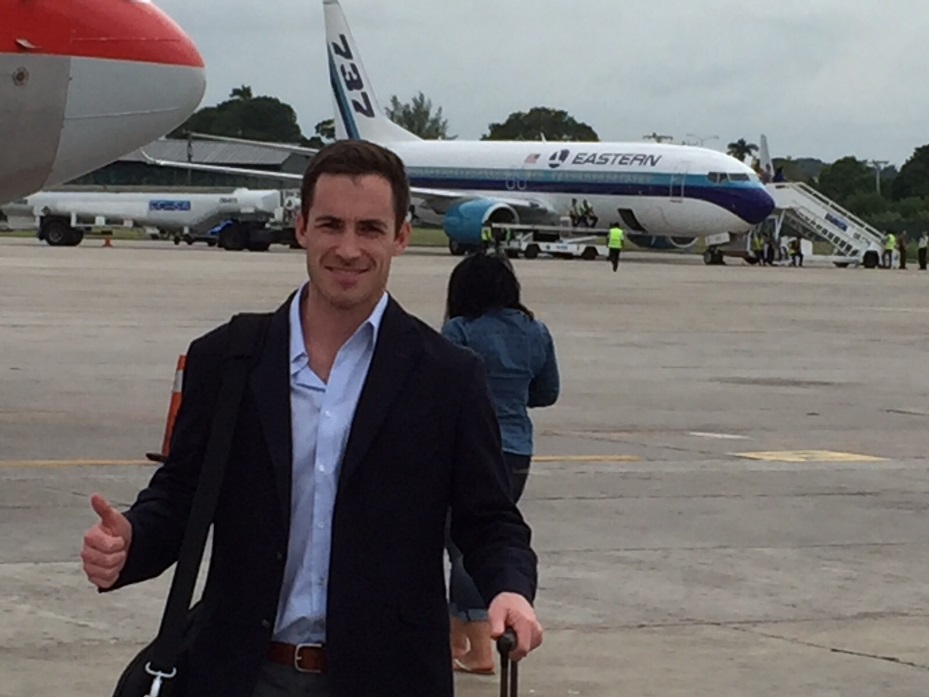
Organizing the appropriate documentation turned out to be much easier than I expected. I bought a round trip flight to Miami, then coordinated the required Cuban flight and visa through a company called ABC Charters (though I believe commercial flights are opening soon so this may not be necessary). I was nervous prior to leaving Chicago for Miami, especially the day prior when we hadn’t received our Cuban visas or actual tickets from Miami to Havana. The representative from ABC just told us to show up at the gate and all the documentation would be waiting for us there. I’ve traveled enough in Latin America to be suspicious when hearing in Spanish “don’t worry, everything will be in order”, but luckily, she was right. We arrived in Miami four hours early, waited in line at the terminal for an hour until they handed us the required tickets and documentation. After a 45 minute chartered flight of an American Airlines plane, we landed in Havana.
In some ways visiting Cuba is a level of culture shock that I hadn’t experienced since visiting Asia. The country is very poor – the average salary is $20 USD per month – with infrastructure in as poor a state as I’ve seen in Latin American. Two of the first things that jumped out at me were the prevalence of antique cars and communist propaganda.
Since the embargo was put in place in 1959, many of cars you see driving people to and from work and taxing tourists around are ones that you would only see in antique car shows in the US.

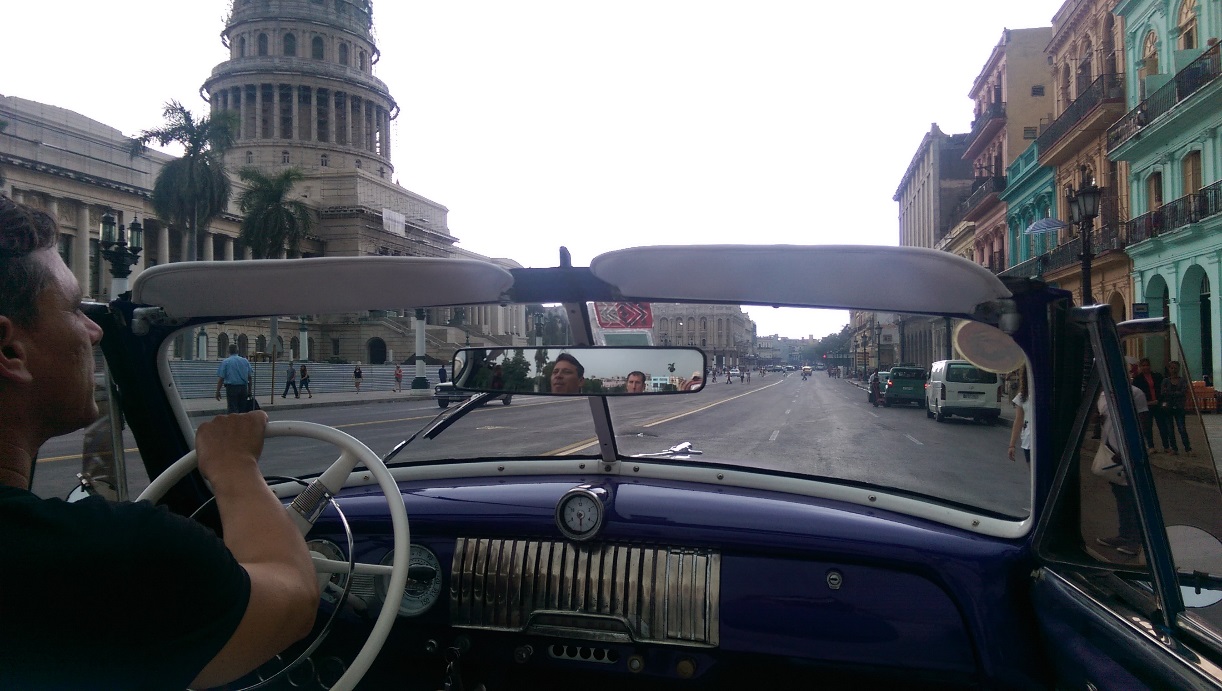
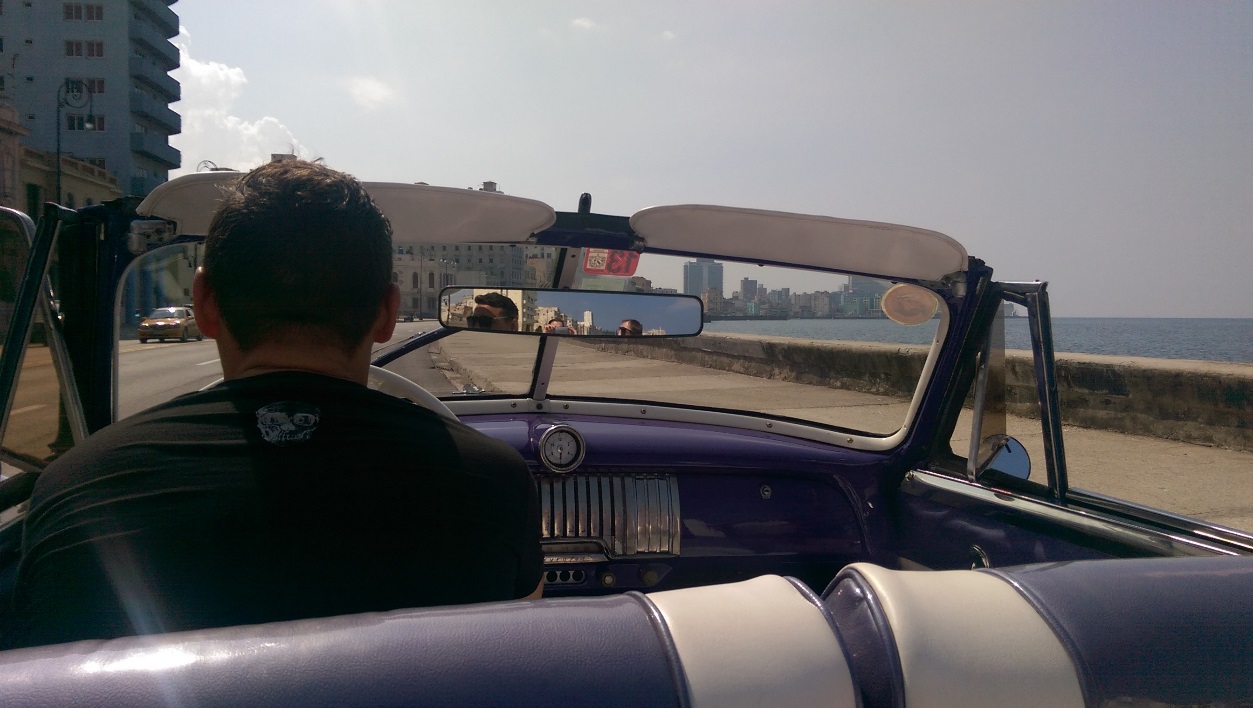
Later on in the trip we hired a driver for an hour to take us on a tour around a city in a purple ’51 Chevy. Given the difficulty of obtaining replacement parts for US cars in Cuba, the driver explained to us all the repairs he made to the car over the years and how they had to get creative, jerry rigging parts to keep the car running.

Driving around the city, it’s impossible to miss the Communist propaganda. The first billboard I saw upon leaving the airport read “Verdadero Ejemplo de Hermandad” (True Example of Brotherhood) and had pictures of Fidel Castro, Hugho Chavez, Simon Bolivar…and Leon Trotsky? I wasn’t sure of the fourth guy.

Another billboard on the main highway from the airport to Havana read “Bloqueo: El Genocidio Mas Largo de la Historia” (Blockade: Longest Genocide in History). And the most memorable work meeting we had on our trip was held with one of the country’s ministers, in a large Soviet-style concrete building. They ushered us into a room with a large, 15-foot likeness of Che Guevara directly behind us.

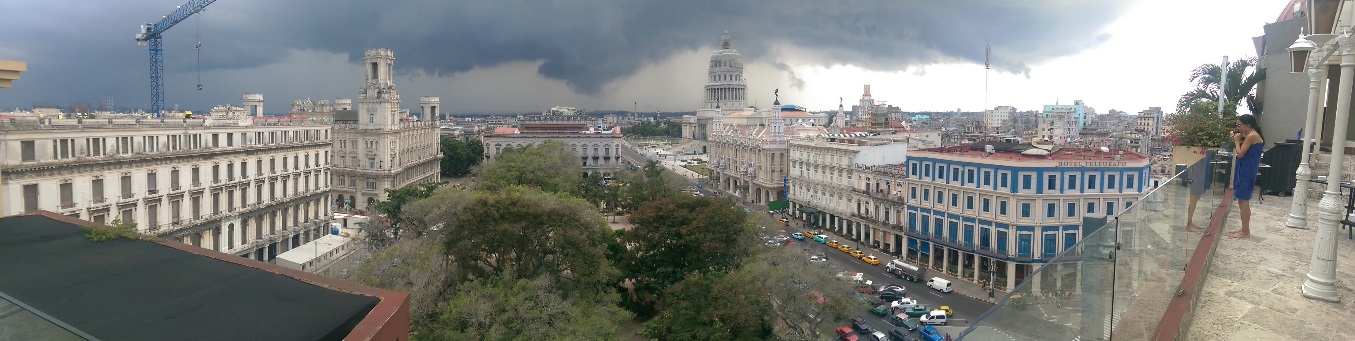
We stayed at the Hotel NH Parque Central, one of the nicest hotels in the city. Overall it was nice, with a rooftop pool, good restaurants and decent service. Even at one of the island’s best hotels, internet access is very limited (as it is throughout the island). Here you had to buy $5 wifi cards that only last an hour, and can only be used in the downstairs lobby or near the rooftop bar. I’d say the internet actually functioned about 50% of the time.
I came away very impressed by the Cuban people. They are warm and open, and surprisingly had no ill will towards the US despite the harsh effects of the embargo. Nearly every conversation started with them asking where we were from. When we replied “Los Estados Unidos”, they were very welcoming and curious, wanting to know which state we were from, how we liked Cuba, and our thoughts on the progress being made in the thawing of relations between our two countries.
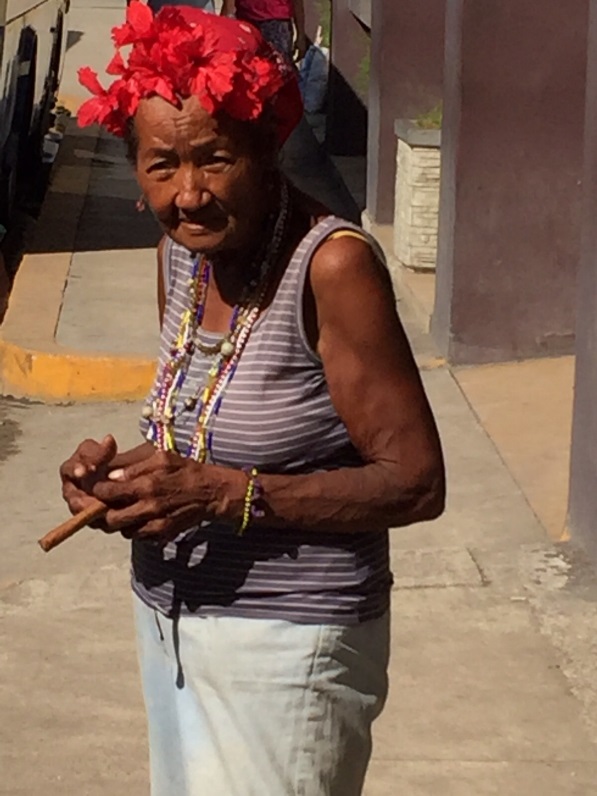
Considering the prevalence of communist propaganda I witnessed and preconceived notions I had about the level of government control, I was surprise to hear many Cubans speak freely about their government – both positively and negatively. Having only spent four days there, I wouldn’t pretend to be able to make blanket statements about how the Cuban people feel. That being said, of the people I spoke with, they were hopeful that Cuba would continue to become more open and engaged in the global economy. Many were careful to acknowledge certain successes that the government has had – particularly in the areas of the Cuban systems of education and universal health care, and the high level of security. However, the primary concern they had was the lack of opportunity that exist on the island.
I saw firsthand one example of this one afternoon when I was buying trinkets to bring back for my family. On a small side street lined with stands full of cheap merchandise, just off one of the main plazas (which plaza), I started a conversation with one of the stand owners. After purchasing a few bracelets and key chains, she told me she only managed the stand part time, because she had another job in the mornings. I asked her what that job was, and she replied that she was a university professor of psychology.
Until the US embargo is lifted, I think economic progress will be slow. Given the continued existence of the embargo and limits on investment and foreign ownership of land for US Citizens, the goal of our trip was more to identify future opportunities than present ones. Despite the intimidating (and ironic) presence of a massive likeness of Che Guevara staring at us during our meetings, we had productive conversations with Cuban officials who were unequivocally promoting private investment. They were acutely aware of the need for foreign participation in the economy – both in terms of capital and expertise – and spoke of actions they were taking to help promote it. They were also very inquisitive as to when we thought the blockade would be lifted.
If you do visit Cuba, don’t expect things to happen efficiently. Patience is key. As you would expect from a communist country, service is poor and trying to do something simple like get money out is nearly impossible (especially for Americans given the restrictions, but for other visitors as well). I was light on cash the last couple days and wanted to get some sent via Western Union. After being sent to two Western Unions and two banks, I gave up and resigned myself to having to drink less expensive rum.
While there remain obstacles to progress in Cuba, I think there are strong fundamentals that could help the country and its people prosper in the coming years. I am hopeful to return soon to see more of this beautiful country, and would encourage anyone interested to do the same.
Here’s my recommendations of things to do in Cuba if you go:
- Pay a taxi driver for a 2 hour drive around the city. In that time you’ll get a good feel for the city and see many of the major tourist attractions like Old Havana, the Malecon, El Morro, Christopher Colombus Cemetery and the nearby park, US Embassy, El Capitolio, Plaza de la Revolucion (where Fidel gave many of his speeches), and others.
- Nightlife: El Gato Tuerto was my favorite place. Had fantastic Cuban music and a good vibe. Went to Casa de la Musica also (there are two), which are fun but more of a tourist trap. The one in the Center of Havana is pretty edgy, it gets a younger crowd, while the one in Miramar seemed more laid back (or maybe we just went on an off night).
- Shopping: I won’t be much help here, I spent most of my money on little trinkets, rum and cigars – all of which are everywhere you go. Just be careful to check the dollar limit on US customs for Cuban cigars and alcohol before you go.
One thing to watch out for though, many will try to sell you discount cigars. I don’t know enough about cigars to say if ones are good or not, so I spent my money on ones in officially shops. But one of the attempted sales was pretty impressive…while walking through a touristy street off the bar Floridita (across from the Museum of Fine Arts), three different people came up to us, at separate times, mentioning that today was “National Cigar Day” and there was a Cigar Fair nearby with discount cigars in bulk. We figured this was more than a coincidence, so we decided to walk down the street to check it out, but still not expecting much at this point. While walking towards the location a woman came up to us, claiming to be our server from Hotel Parque Central (we didn’t recognize her), and recommended we check out the Cigar Fair just inside the courtyard to the left. At this point we were sufficiently intrigued to go in and check it out. It turned out there was no fair, but just one guy at a table with a bunch of brand name boxes filled with unmarked cigars. Each of the people who mentioned the “Cigar Fair” or “National Cigar Day” most likely would have profited from the sale of any cigars here. Since they were only about 25% less than the ones in shops, we opted not to buy any…though the level of coordination on their part was pretty impressive.

 Lena's Traveler's Talk
Leave a comment